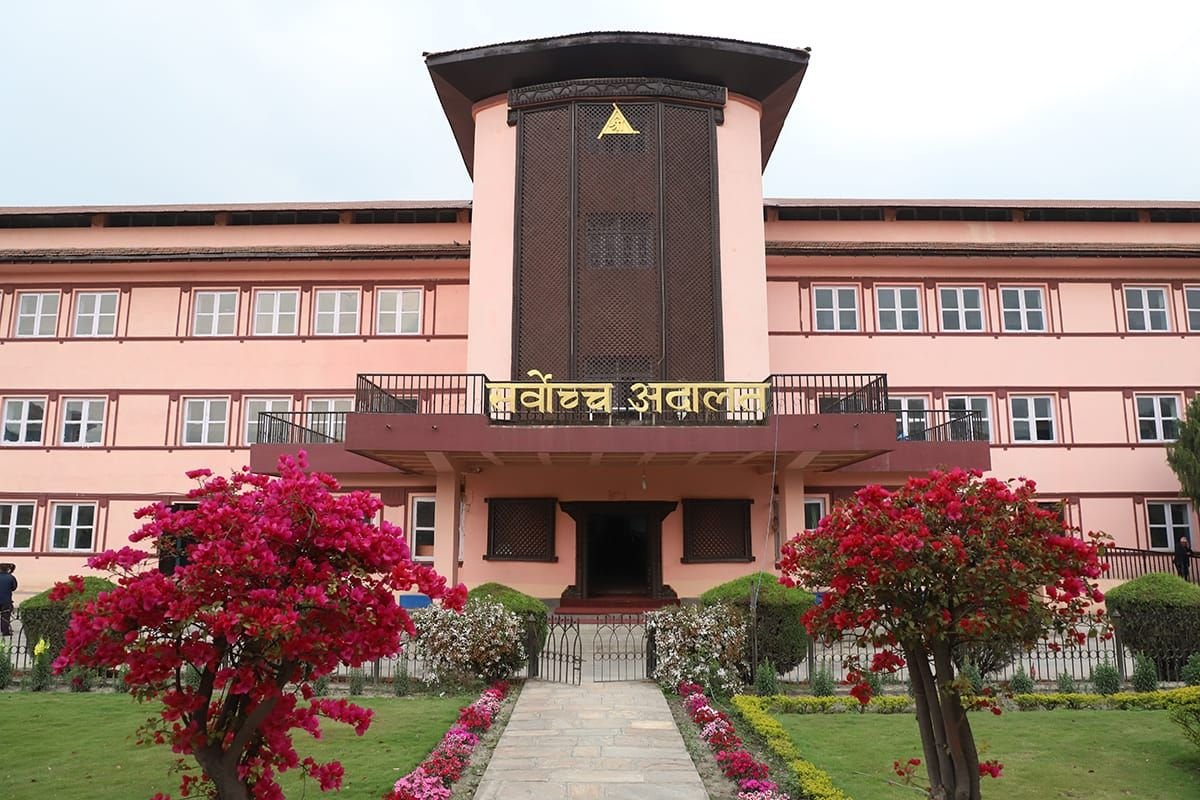
Kathmandu: The Supreme Court has issued significant guidelines on the legal procedures the state must follow when using private land for public roads and development projects, including landowners’ consent, compensation and rehabilitation.
A joint bench of Justices Hari Prasad Phuyal and Meghraj Pokharel issued the ruling in a writ petition filed by Chopindra Bahadur Tamang against the Road Division Office, Harkapur, Okhaldhunga, among others. The full text of the verdict, delivered in June (Asar), was released on Tuesday.
The court said a balance must be maintained between private property rights and public development. It also directed the government to amend the Land Acquisition Act, 2034, stating that the existing law is not fully compatible with Nepal’s federal structure.
Consent required to build public infrastructure on private land
The court made it clear that the state cannot freely construct public roads or other infrastructure on private land without the landowner’s consent.
Public infrastructure can be built on private property if the owner agrees. However, where consent is not given, the government must acquire the land by following the complete procedure prescribed by the Land Acquisition Act.
The court said public purpose, payment of compensation and damages, and compliance with the prescribed legal process are mandatory.
Development cannot justify taking private property
The Supreme Court said development is a responsibility of the state, but development projects cannot violate citizens’ fundamental rights to property and housing.
Government agencies cannot use private property simply because doing so is convenient for them, the court said, adding that the state has a responsibility to balance development needs with citizens’ property rights.
The ruling is expected to place legal limits on the practice of using the justification of “public interest” alone to acquire private land for roads, bridges, buildings, airports and other infrastructure projects.
Completed roads do not make unlawful acquisition lawful
The court also established that the state’s failure to follow due legal procedures does not automatically become lawful merely because a public road has already been constructed.
However, where a completed road has become an important public asset, the authorities must balance public and private interests before deciding to demolish or relocate it, the court said.
Authorities should examine alternatives, including whether the road can be relocated and whether the remaining portion of the affected land can still be used.
If relocation is not feasible, the government must acquire the land in accordance with the law and provide the landowner with appropriate compensation and damages.
Loss of usability of remaining land must be assessed
The court said compensation should not be limited to the area of land directly occupied by a road.
If the remaining portion of a property becomes unsuitable for residential or other purposes because of road construction, the resulting loss to the landowner must also be assessed.
This means compensation should take into account not only the area acquired but also the impact of the project on the usability and value of the remaining property.
Rehabilitation required in cases of displacement
The court said compensation alone may not always be sufficient where land acquisition results in displacement.
Where people are displaced because of land acquisition for a public project, the state must also make arrangements for their rehabilitation and resettlement, according to the ruling.
The decision therefore expands the state’s responsibility beyond financial compensation to ensuring the proper resettlement of people affected by infrastructure projects.
Landowners and local communities should be involved
The Supreme Court stressed the need to ensure the participation of affected landowners and local communities in the land acquisition process.
Landowners should be given an adequate opportunity to be heard before their land is acquired, while local communities should also be involved in the process, the court said.
Compensation system should be objective and predictable
The court noted that the existing Land Acquisition Act does not provide sufficient objective criteria for determining compensation.
It directed the government to establish an objective system that takes into account the actual economic value of land, losses incurred from relocating homes or businesses, and other financial losses resulting from land acquisition.
Future compensation, therefore, should not be based solely on administrative valuation but should also reflect actual economic losses, according to the ruling.
Land acquisition powers should not remain limited to the federal government
Another significant aspect of the ruling concerns federalism.
Under the existing Land Acquisition Act, land required for development projects operated by provincial or local governments must also be acquired through the federal government.
The Supreme Court said this arrangement is inconsistent with Nepal’s federal structure and directed the government to formulate legislation allowing the government level responsible for a particular development project to carry out the land acquisition process.
The ruling could pave the way for provincial and local governments to independently acquire land for projects such as roads, hospitals, schools, drinking water schemes and rural infrastructure, rather than depending on federal ministries.
Separate mechanisms needed to resolve land disputes
The court also directed the government to establish mechanisms at the federal, provincial and local levels to hear complaints, investigate disputes, facilitate mediation and make decisions on land acquisition and compensation issues.
It further called for a provision allowing affected parties to appeal such decisions before the appropriate court.
The move is aimed at providing an alternative to prolonged disputes over land acquisition and compensation remaining unresolved in courts for years.
Land acquisition process must have a time limit
The Supreme Court said land acquisition proceedings should not be allowed to continue indefinitely and directed the government to introduce a fixed time limit for completing the process.
The provision, it said, would help development projects move forward on time while preventing landowners from being left in prolonged uncertainty over the status of their property.
What happened in Tamang’s case?
Tamang’s case concerns the construction of a road from Palapu–Tapkedanda–Koshbhanjyang to Kakani in Champadevi Rural Municipality of Okhaldhunga.
The road was constructed through Tamang’s plots numbered 44 and 46. Tamang claimed that, according to the survey map prepared by the Road Division Office, the road was supposed to pass through a different section of his land but was instead constructed through the middle of his property.
The Supreme Court did not issue an order to quash the construction decision, stating that the road had already been completed. However, it ruled that construction carried out without the landowner’s consent and without following the prescribed legal process could not be considered lawful.
The court therefore ordered the concerned authorities to examine the condition of the land and, if possible, provide an alternative route for the road. If relocation was not feasible, it ordered the authorities to determine compensation and damages in accordance with the law and proceed with land acquisition.
Government directed to amend land acquisition law
The Supreme Court has directed the government to incorporate several provisions when amending the existing land acquisition legislation, including:
- Clearly defining which level of government has authority over particular development projects.
- Allowing the relevant level of government to carry out the land acquisition process.
- Ensuring participation of landowners and local communities.
- Providing landowners with an adequate opportunity to be heard.
- Determining compensation based on the actual economic value of land and other losses.
- Completing land acquisition proceedings within a specified timeframe.
- Establishing appropriate dispute-resolution mechanisms at federal, provincial and local levels.
- Ensuring speedy resolution of disputes concerning compensation and damages.
The central message of the ruling is clear: private land can be acquired for a genuine public purpose, but the state cannot seize private property by bypassing the law in the name of development.
Even when public infrastructure must be built, the Supreme Court has said that legal procedures, property rights, fair compensation, damages and, where necessary, rehabilitation must move forward alongside development.