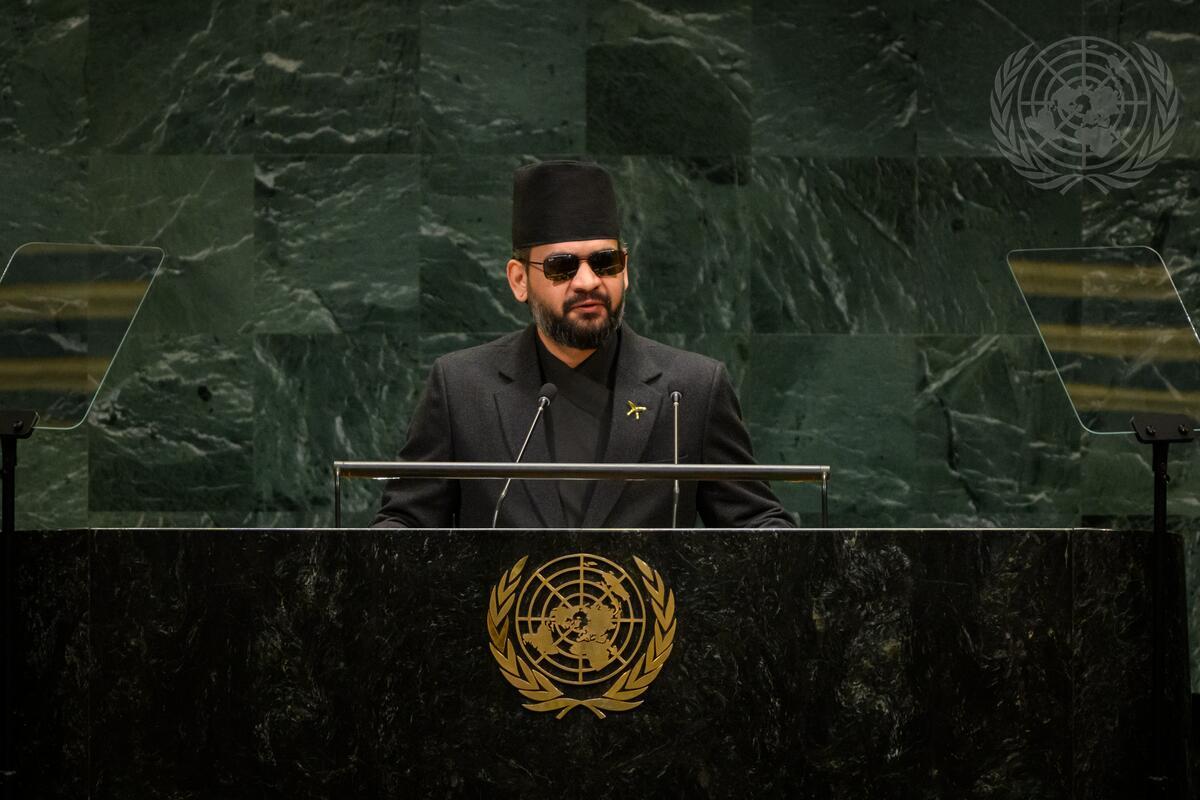
NEW YORK: Prime Minister (PM) Balendra Shah, addressing the 81st session of the United Nations General Assembly (UNGA), said the recent Bhotekoshi flood in Nepal was a warning not only to Nepal but to the entire world.
Speaking at the General Assembly at the United Nations Headquarters in New York, he asked, “The Bhotekoshi flood was a warning to the world, did you hear it?”
Referring to remarks by United Nations Secretary-General Antonio Guterres, Prime Minister Shah said the scientific community had been warning for years about the growing threat of climate-related disasters. He said Nepal had suffered significant loss of life and property in the recent devastating floods and stressed that the crisis was not caused by Nepal but was a consequence of global climate change.
During his address, Shah said Nepal did not intend to blame any country or turn the issue into a geopolitical matter. Instead, he called on the international community to work together to protect the mountains and the environment.
He also urged the international community to provide the necessary support to Nepal as it works to recover from the disaster and address the challenges of the post-disaster situation.
Prime Minister Shah also said that the recent floods and landslides in Nepal have caused significant loss of life and property, stressing that the crisis is not the result of local factors but of global climate change.
PM Shah appealed to the international community for cooperation and support to help Nepal overcome the challenges arising from the disaster.
During his address, Shah made it clear that Nepal does not seek to blame any country for the climate crisis or turn the issue into a matter of geopolitical interest. He urged the international community to unite and work together for the sustainable protection of the Himalayas and the environment.
Addressing the UNGA, he termed the Bhotekoshi floods as a “Himalayan Tsunami,” and stressed that the floods should not be viewed solely as a national tragedy.
“The Bhotekoshi-Trishuli disaster was not just a local tragedy; it was a warning to the world,” Shah told the General Assembly. “And I ask you today: have we really heard that warning?”
“I come before you from Nepal, a distant country in the Himalayas, carrying a close warning for humanity,” he said.
Shah described the scale of the destruction, saying families were still waiting for news of missing relatives while communities searched through mud and debris for victims. Roads, bridges, schools, homes and sources of livelihood were also destroyed within a short period.
He linked the disaster to the wider effects of a warming climate, saying the fragile Himalayan ecosystem was becoming increasingly unstable. He cited melting permafrost, unstable slopes, ice-rock avalanches, floods and landslides as interconnected climate-related threats.
The disaster affected areas on both sides of the Nepal-China border, while floodwaters continued downstream toward India, highlighting the importance of regional cooperation. “Climate change does not recognise borders,” Shah said. “Glaciers and floods do not travel with a visa stamped on passports.”
Although Nepal accounts for less than 0.1 percent of global greenhouse-gas emissions, Shah said the country is experiencing retreating glaciers, increasingly unstable mountain slopes and less predictable rivers.
He warned that repeated major disasters could erase years of development gains. “For Nepal, climate catastrophe is not just a humanitarian event, but a development emergency,” he said.
Referring to the human and economic impact of the Bhotekoshi disaster, Shah said at least 1,400 deaths had been confirmed and more than 6,000 people remained missing. Preliminary assessments, he added, indicated that the cost of physical recovery could amount to around 10 percent of Nepal’s GDP.
Shah called for increased international assistance for recovery and reconstruction, arguing that climate-vulnerable countries should not be forced to take on additional debt to rebuild infrastructure destroyed by climate-related disasters.
“When a climate-driven disaster destroys the infrastructure of a poor country, the answer cannot simply be another mega loan or a patchwork of small grants,” he said. “We need adequate grant-based support from the world.”
He also argued that existing climate-finance mechanisms, including the Loss and Damage Fund and the Global Environment Facility, were insufficient. He called for funding procedures to be made simpler and faster. “When the house is burning, we do not ask the family to complete fifty forms,” Shah said. “We act.”
Shah proposed establishing a Himalayan Climate Resilience Mechanism involving Nepal, India and China to improve the region’s capacity to anticipate and respond to climate-related disasters.
The proposed mechanism would promote the exchange of satellite information and technical expertise, monitoring of high-risk glacial lakes, stronger regional early-warning systems and coordinated cross-border disaster response.
He said the Himalayas should serve as a “laboratory of international cooperation” rather than a region where vital climate and disaster information remains fragmented.
According to Shah, the Hindu Kush Himalaya supports nearly two billion people and provides water resources, ecosystems, agricultural systems and livelihoods well beyond Nepal. “The Himalayas are not peripheral to the planet. They are part of the planet’s life-support system,” he said.
Shah also highlighted Nepal’s domestic efforts to strengthen climate resilience. He said forests now cover nearly half of the country and that Nepal is expanding hydropower, electric mobility and locally led climate adaptation measures. However, he stressed that Nepal could not address the risks alone.
He urged countries to adhere to the principle of common but differentiated responsibilities and respective capabilities under the UN climate framework. Countries with greater historical responsibility for greenhouse-gas emissions and greater capacity to respond, he argued, should assume greater responsibility.
“Climate justice cannot just remain a beautiful phrase in a United Nations document,” Shah said.
He further called for a transition from primarily responding to disasters after they occur toward greater preparedness. As climate patterns change, he said, traditional assumptions about risk are becoming increasingly unreliable.
“Our baselines are no longer relevant,” Shah said. “And we must move from ad hoc responses to a culture of preparedness.”
Shah called for increased investment in climate-resilient infrastructure, insurance, technological innovation and early-warning systems, alongside efforts to reduce dependence on fossil fuels.
Meanwhile, Prime Minister Shah said the elections held on March 5 were the most peaceful and fair in Nepal’s history. He conveyed to the international community that the elections, in which the Rastriya Swatantra Party (RSP) secured nearly two-thirds of the vote, had contributed to political stability and opened a new direction for the country.
Prime Minister Shah concluded his address to the United Nations General Assembly in Nepali. After delivering his speech in English, he concluded by saying, “May Lord Pashupatinath bless the entire world. May we all follow the path shown by Buddha.”