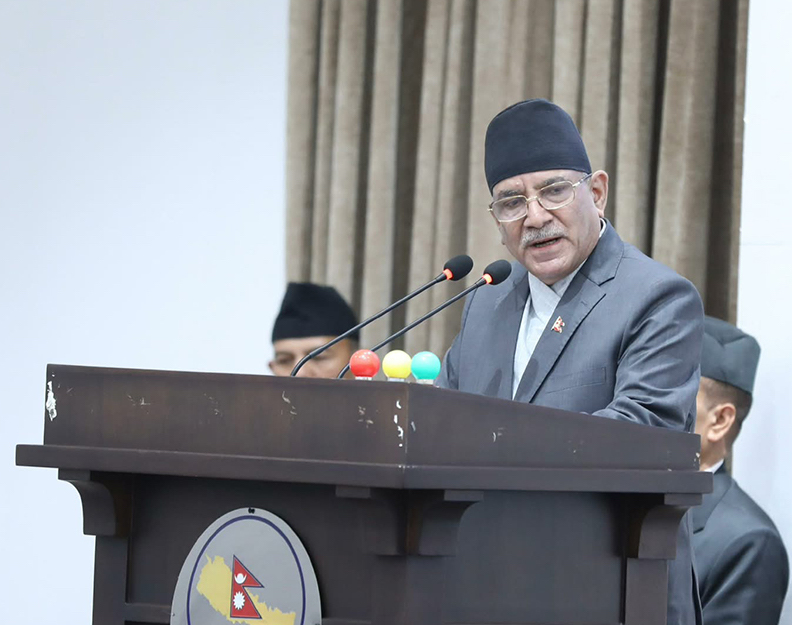
KATHMANDU: Pushpa Kamal Dahal ‘Prachanda’, Coordinator of the Nepal Communist Party and former Prime Minister, has said that the current federal parliament feels inclusive to him, regardless of who enters it, emphasizing that it reflects the outcome of a long political struggle.
Speaking in the House of Representatives, Prachanda stated that Nepal’s parliament has become inclusive because of the armed struggle and sacrifices made during the insurgency period.
He remarked that even political figures such as Kathmandu Mayor and political leader Balen Shah entering national leadership roles reflect what he described as a victory of revolutionary commitment.
He also extended greetings and recalled past cooperation with the Rastriya Swatantra Party (RSP), noting that he had worked closely with its leadership in both government and opposition roles. He specifically mentioned RSP leader Rabi Lamichhane, highlighting constructive political collaboration on issues of governance and reform.
Prachanda strongly rejected the narrative that labels all “old leaders and old parties” as the same. “That is not the truth,” he said, arguing that political judgment should be based on “right and wrong, not old and new.” He added that such generalized narratives can create unnecessary division in society and politics.
He defended his party’s record, claiming achievements in good governance, service delivery reforms, meritocracy, investigations into major corruption cases including the Lalita Niwas land scam and Bhutanese refugee fraud, and action against powerful syndicates. He also said that even with limited opposition strength, his party actively resisted irregularities under a two-thirds majority government.
Highlighting parliamentary inclusion, Prachanda described the current representation of women, Dalits, Indigenous communities, Madhesis, Muslims, Tharus, and other marginalized groups as a historic achievement. He called it a “story written in blood and sacrifice,” referring to decades of political struggle and conflict.
“Whoever enters this parliament, I feel as if I have entered myself,” he said, emphasizing pride in the expanded representation. He credited the armed movement and revolutionary struggle for opening the doors of political participation for historically excluded communities.
Prachanda concluded that the true measure of politics is not whether leaders are old or new, but whether they stand for justice, transformation, and inclusion.